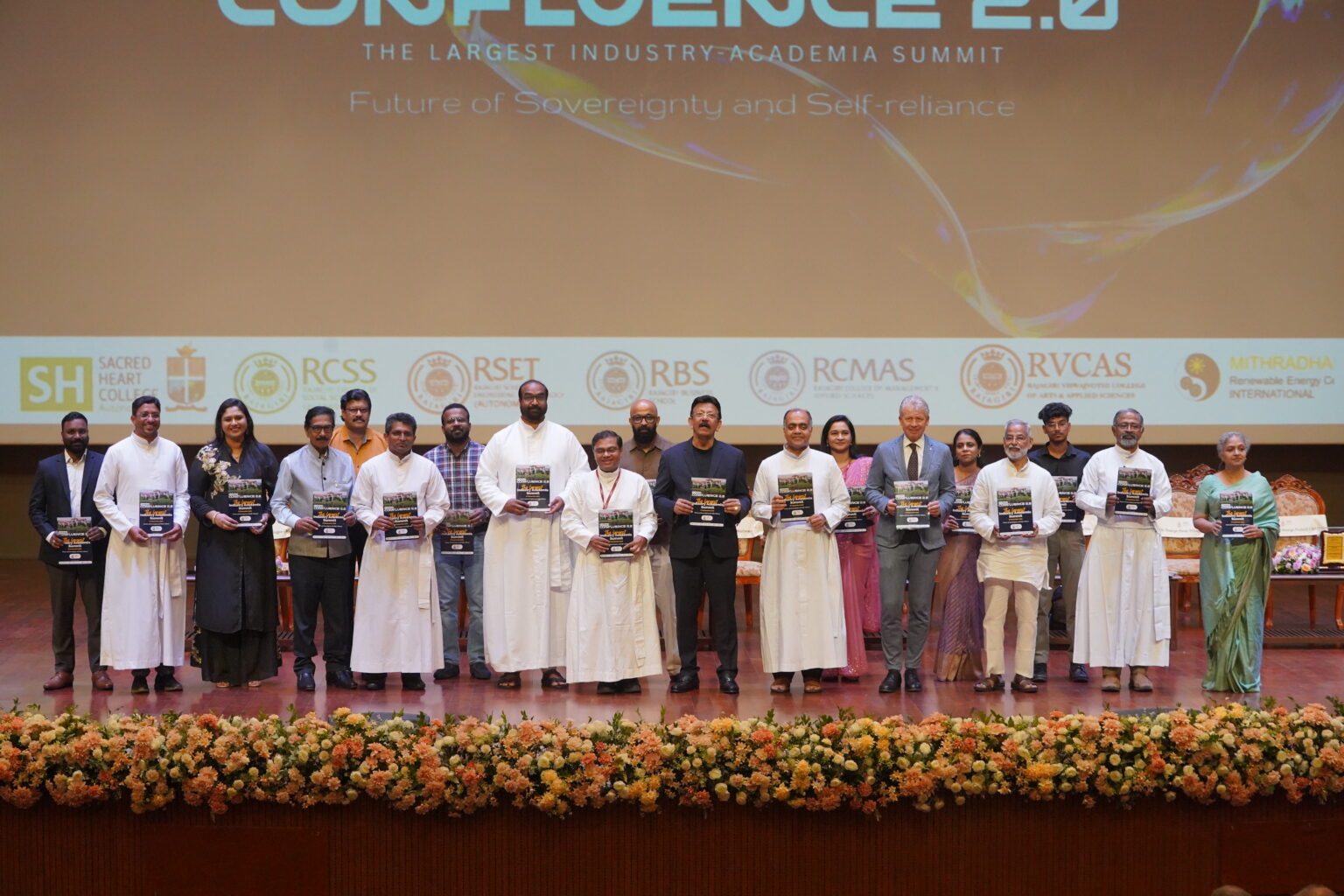


PC: RSET Media Team
“Confluence 3.0 is on” were the exact words spoken by Mr. V.K Mathews, Founder Chairman of IBS Software Services, in the presence of Shri Pinarayi Vijayan, Chief Minister of Kerala. Confluence, once a single-day event, has now grown into a week-long summit — pulling industrialists and academics from all over the state to dine, discuss, and ideate over the present state of our country and the promise for a better future in the world of technology.
Confluence was born during a panel discussion attended by RSET’s Principal, Rev. Dr. Jaison Paul Mulerikkal CMI, alongside Infopark CEO Susanth Kurunthil. The former expressed the need for support from the industry, and the latter echoed the sentiment — that the industry also requires more interaction with academia. Thus came the revelation — despite being physically next to each other, there is indeed a gap between academia and the industry. A handful of students are placed in Infopark but there is no deeper interaction beyond that.
With the problem now clearly presented in front of them, they realised that a solution was needed. “A conversation, of sorts, between the ‘techies’ and the academia needs to start, and for that a platform needs to be put out — a gathering,” Fr. Dr. Jaison Paul said.
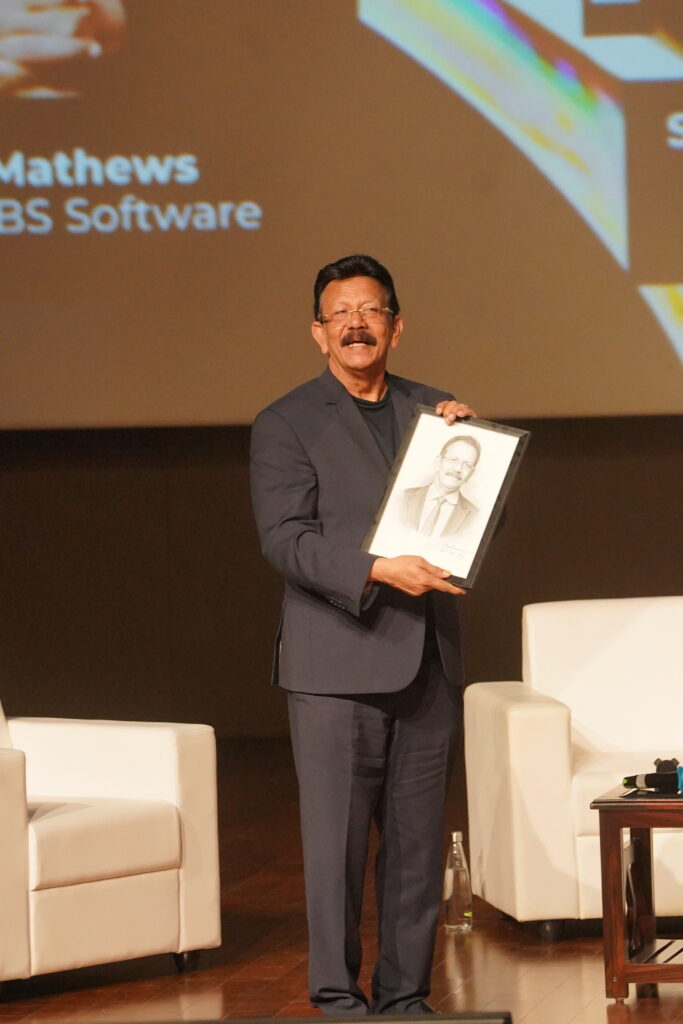
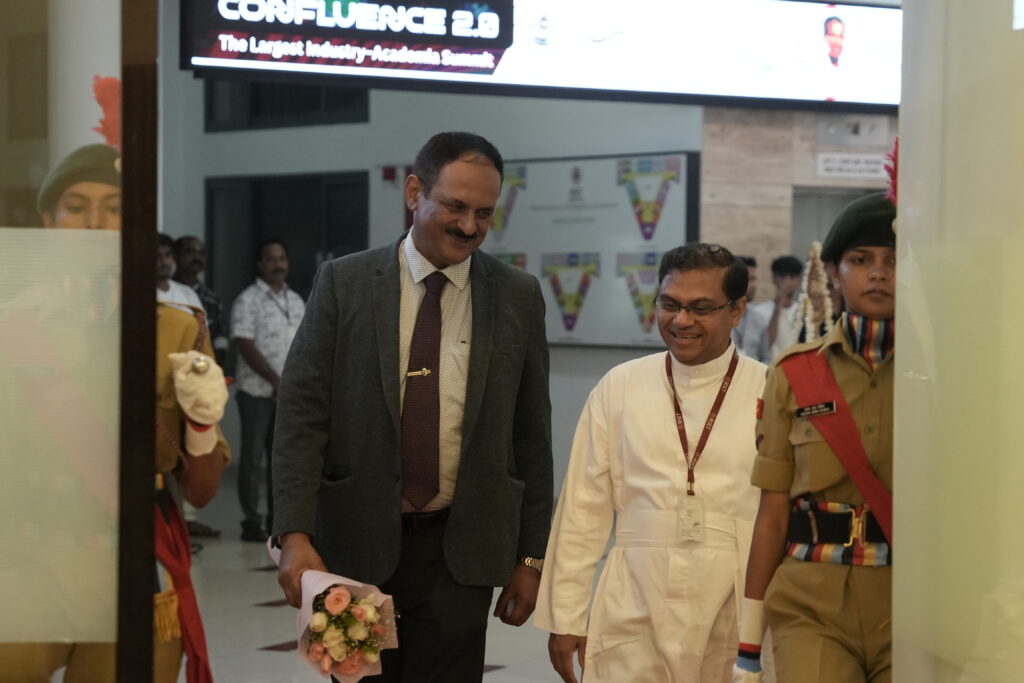
The astounding success of the first edition of Confluence renewed confidence and enthusiasm for Confluence 2.0. It served as a platform for Rajagiri’s sister institutions to come together for a greater cause, while also providing an avenue to bridge the gap between industry and academia — a bridge that grows stronger with each new edition of Confluence. Leading industrialists consider this venture as their own, and they are more than willing to provide the resources for it to grow.
The theme of Confluence 1.0, “The Future of Talent”, was born from the realization of the changing nature of talent itself due to technological advancements such as the rise of artificial intelligence. By the time Confluence 2.0 rolled around, the landscape had shifted once again, with growing concerns over global isolationism imposed by U.S. President Donald Trump’s tariffs and the decline of free trade. This naturally resulted in the theme evolving into “The Future of Sovereignty and Self Reliance”, a theme that resonated with industrialists and academics alike. With the recent global trends affecting IT and Information Business sectors, the CIO association remarks how pertinent the theme is for the future of Indian industries.
With Generation Z at the forefront of the tech revolution, it is of utmost importance that these sessions leave a lasting impact on them. “Whether you become the job-giver, or the employee, this will affect you. You can’t ignore the current geopolitical canvas.”
Confluence 2.0 was not just a summit; it was a week-long immersive experience, with the agenda of including youth through art, culture and social initiatives. The holistic approach towards Confluence 2.0 included cultural programs such as Insomnia, a mentalist show performed by Mr. Aathi, a dance performed by Pravaaha, RSET’s dance club, and many more similar events. “When dealing with youth, you cannot move on without art and culture”. This notion embodies the philosophy of Advaita – the sense that everything is part of one whole. Art, culture, intellect, innovation – none of them stand alone; they move together, shaping a complete development of one’s identity.
The major difference between the two editions was the fact that more of RSET’s departments were involved, which contributed to the increase in industrialists attending, from 350 last year to 400 this year. This growth, however, came with its own set of problems.
It’s hard to cater to two different age groups at once.“We’re bridging that gap by coming together, ideating together, listening together, debating together and finally eating together,” Fr. Dr. Jaison Paul states, “That togetherness represents Confluence.”
Large groups from companies helped boost attendance but brought about another problem — the clash of work timings. At first, there was discussion of Confluence being held on a Wednesday, but the event organisers soon realised that it wouldn’t be ideal, as it was a working day, and many employees would be working remotely.
So they adapted, and considered Saturday. The only downside was that Saturday wasn’t a working day and companies aren’t permitted to send their workers in bulk. Despite all these hurdles, the organisers saw the light at the end of it. They chose a different strategy, one that required our departments to be more hands-on and involved. Academics from departments were asked to contact and invite the industrialists themselves.
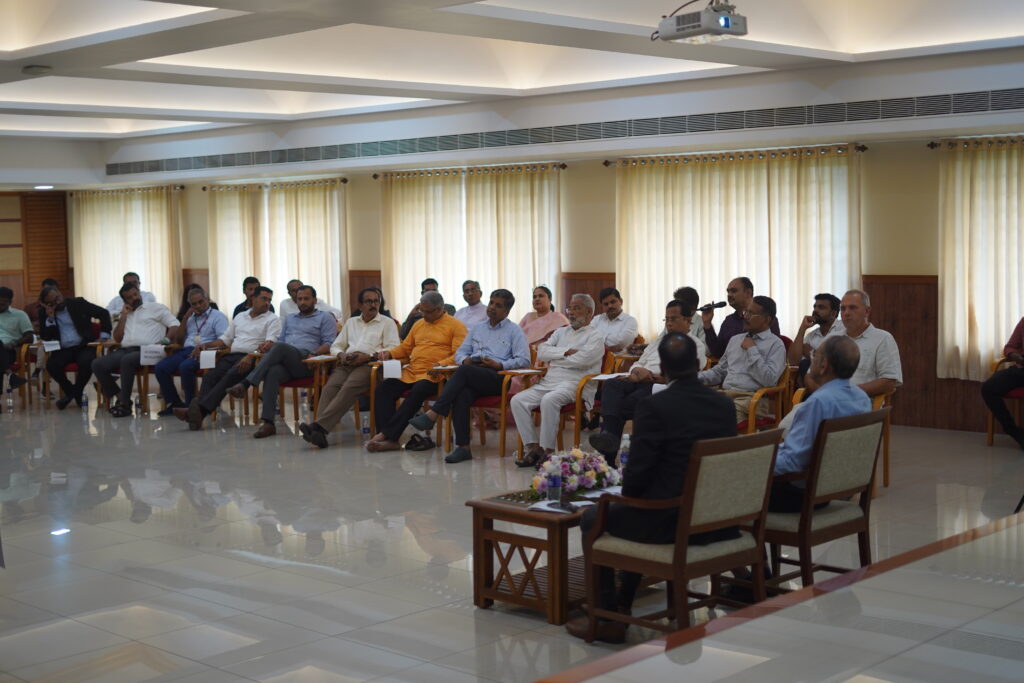
The outcome was remarkable. With an increased number of industrialists spanning a wider range of industry, and an even wider range of academic representatives — Confluence 2.0 proved to be a greater accomplishment than anyone ever expected.
The main topic for this year’s Confluence was “Future of Sovereignty and Self-Reliance”. A topic that is not only relevant to the industrialists working 9-5 jobs but also to the students whose future will play out in a similar tone. Fr. Dr. Jaison Paul hypothesised that the main problem was that the Indian industry focused only on short term gains, with no acknowledgment of the future. The lack of research and awareness of the ongoing global crisis, he added, has further impacted the industry negatively.
It’s a conversation worth having – not just for students to understand the predicament they’re in and the reality of the geopolitical landscape, but also for industry leaders to see that there is a way forward. Confluence 2.0 points out what hurdles we face as a nation, and how we can overcome them. Fr. Dr. Jaison Paul states that China had no problem because they had their own original resources, whereas India was struggling since they had put all its eggs in one basket.
The Diplomat’s article ‘China’s Lesson for India on Weaponized Interdependence’ by Srijan Shukla, illustrates how China’s restrictions on exporting critical machinery to India directly affected the Indian industries. Without crucial machinery, there was an inevitable stall in the production of electronics and solar appliances; which in turn, slowed the economy and affected the standard of living across the country.
“The industry realized that they’ve got a sizable problem on their hands, as all this time, they’ve been depending on the reliability of outsourcing work — but that is hurting us, that is hurting the industry, and that is very visible”, says Fr. Dr. Jaison Paul.
Many successful collaborations arose from Confluence, ranging from the MoU signed on 22nd January 2025 with RSET & Acoustic and Computing Solutions Pty Ltd (ACS) Australia to the MoU signed on 15th February 2025 with RSET & Hochschule Ravensburg-Weingarten — University of Applied Sciences (RWU), Germany. However, the greatest achievement could possibly be that the staff members of RSET can now directly call an industrialist, fostering genuine and ongoing collaboration.
This year’s Confluence expanded beyond colleges and companies, and into schools, starting with “The Ultimate School Students Convergence”, jointly organized by RSET and Rajagiri Viswajyothi College of Arts & Applied Science. With the support of MeitY, a Central Government Agency, this collaboration opened the doors for school students to be a part of Confluence, and the response was remarkable. Fr. Dr. Jaison Paul noted that many school students today are exceptionally skilled, often more technologically adept and creatively engaged than engineering undergraduates. He jokingly recalls a conversation he had with a senior, who admits that they’re “afraid of the first-years because they know so much more than us”.
The focal point of Confluence was to bridge the gap between industrialists and academia and now it has done its part in creating a pathway for academia and industry workers to help each other and build connections. Confluence 2.0 is proof of the combined strength of teamwork and a common goal between academia and industrialists. What started out as a simple project to encourage communication between academia and business has grown into a movement that is deeply rooted in awakening people to the reality we have found ourselves in.
This dialogue ensures that innovation grows through people coming together from all walks of life. “People are warming up. Human interaction is the first thing that needs to happen,” Fr. Dr. Jaison Paul remarked, “and I would say…that is the greatest thing.”