
As we grow up, we often hear labels attached to us: “You’re so creative and good at drawing, you belong in the arts,” or “You’re logical and good with numbers, you should become an engineer.” Right after tenth grade, we’re encouraged to commit to a single career path, usually framed as a choice between two opposing worlds. Most of the time, these paths are treated as mutually exclusive.
This divide between “artistic” and “scientific” minds is not supported by research in creativity or cognition. The division we are taught to see in our formative years is therefore cultural rather than psychological. In reality, science and art are two sides of the same coin.
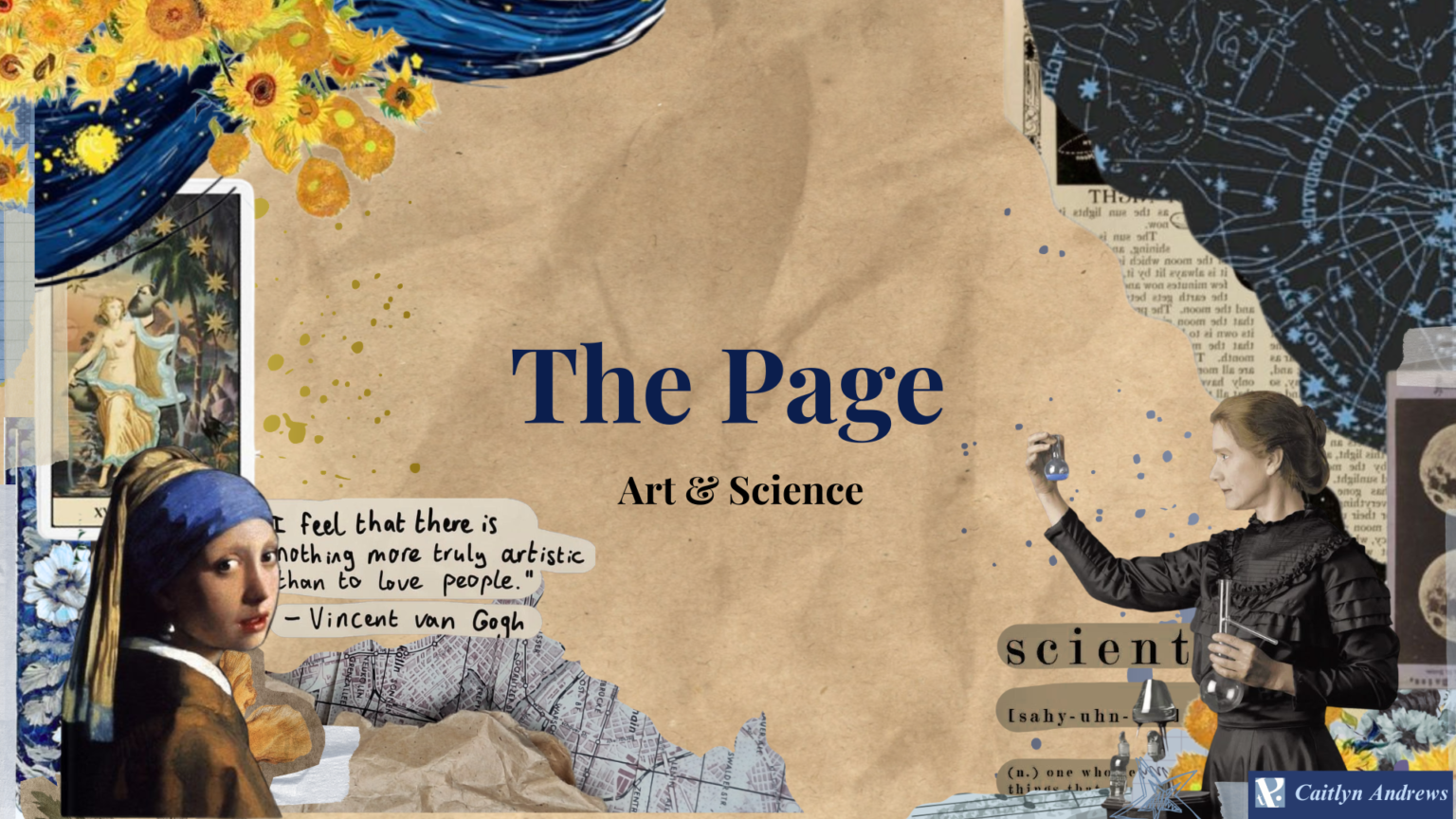
There are more and less obvious ways in which the scientific process merges with art, as demonstrated by some of the greatest scientists and artists to ever live. Leonardo da Vinci, for one, never questioned whether he was an artist or a scientist. He simply was both. His paintings grew out of his close study of anatomy, and his anatomical drawings carried the same perceptiveness and precision he brought to his art.
Another great example is Albert Einstein, who looked beyond the limits of contemporary physics to develop new ways of understanding the fundamental nature of reality, whilst maintaining a steady passion for the violin. Then there’s Ada Lovelace, revered for coming up with the method to calculate Bernoulli numbers, essentially creating the first computer algorithm. Moreover, she was an incredible writer who explored the philosophy of machines, the role of imagination in scientific discovery, and the possibility that computation could one day shape music, language, and symbolic expression.
Marie Curie too was an artist, and so were Katherine Johnson and Charles Darwin. All these brilliant minds thought creatively about the world around them, founding entire new fields of research or changing the course of science’s history. They show that the mind is capable of moving fluidly between ways of knowing and that some of mankind’s most remarkable contributions emerged from that fluidity.
So why do we view art and science as two separate entities? The answer lies in the evolution of modern education and professional fields. As knowledge expanded over the course of time, disciplines became increasingly specialized. Universities and institutions began categorizing knowledge into specific departments and encouraged students to focus on narrow areas of expertise rather than developing general knowledge about a broad horizon of fields.
The more rigid the systems became, the more these categories defined us. Schools labeled some students as analytical and others as creative. Over time, these divisions moved from the structure of institutions into the structure of our identities. We internalized the idea that choosing one meant relinquishing the other. A single strength was allowed to eclipse the rest of a person’s abilities, as if having a talent in one domain automatically disqualified you from another. As if creativity and logic couldn’t coexist.
This is not how the mind operates. We make connections across disciplines without even noticing, taking inspiration from art to understand science and from science to deepen art. Set aside the cultural split and the picture becomes simpler. The qualities that guide a scientist through discovery are the same ones that guide an artist through expression. Noticing connections, recognizing patterns, imagining possibilities—these are shared capacities. All forms of creativity begin with the same mental groundwork.
Analogy. The mind’s most instinctive tools. We make sense of the unfamiliar by relating it to something we already understand. Scientists depend on analogy to test ideas and model new concepts, while artists use it to reveal meaning or emotion. In both cases, analogy serves the same purpose: it makes the abstract graspable.
Pattern recognition. We have a tendency to search for structure and, as a result, are always detecting patterns. In both scientific and artistic contexts, pattern recognition helps us find order in complexity. Of course, to different degrees, but the principle is the same.
Visualization. The ability to see ideas before we can articulate them. Scientists visualize models and mechanisms; artists visualize colors and imagined worlds. In both domains, visualization is the first step toward making an idea real.
The solution to this systemic dichotomy is simple: we need to stop labeling ourselves and others as “art people” or “science people.” These categories limit our potential and ignore the reality that innovation and growth often happen at the edges where disciplines meet.
Neither science nor art is superior; each offers a vital perspective on the world. Science provides an understanding of universal experience, and art provides a universal understanding of personal experience—both are attempts to make sense of the same world from different angles. The future belongs to the minds that refuse the divide.