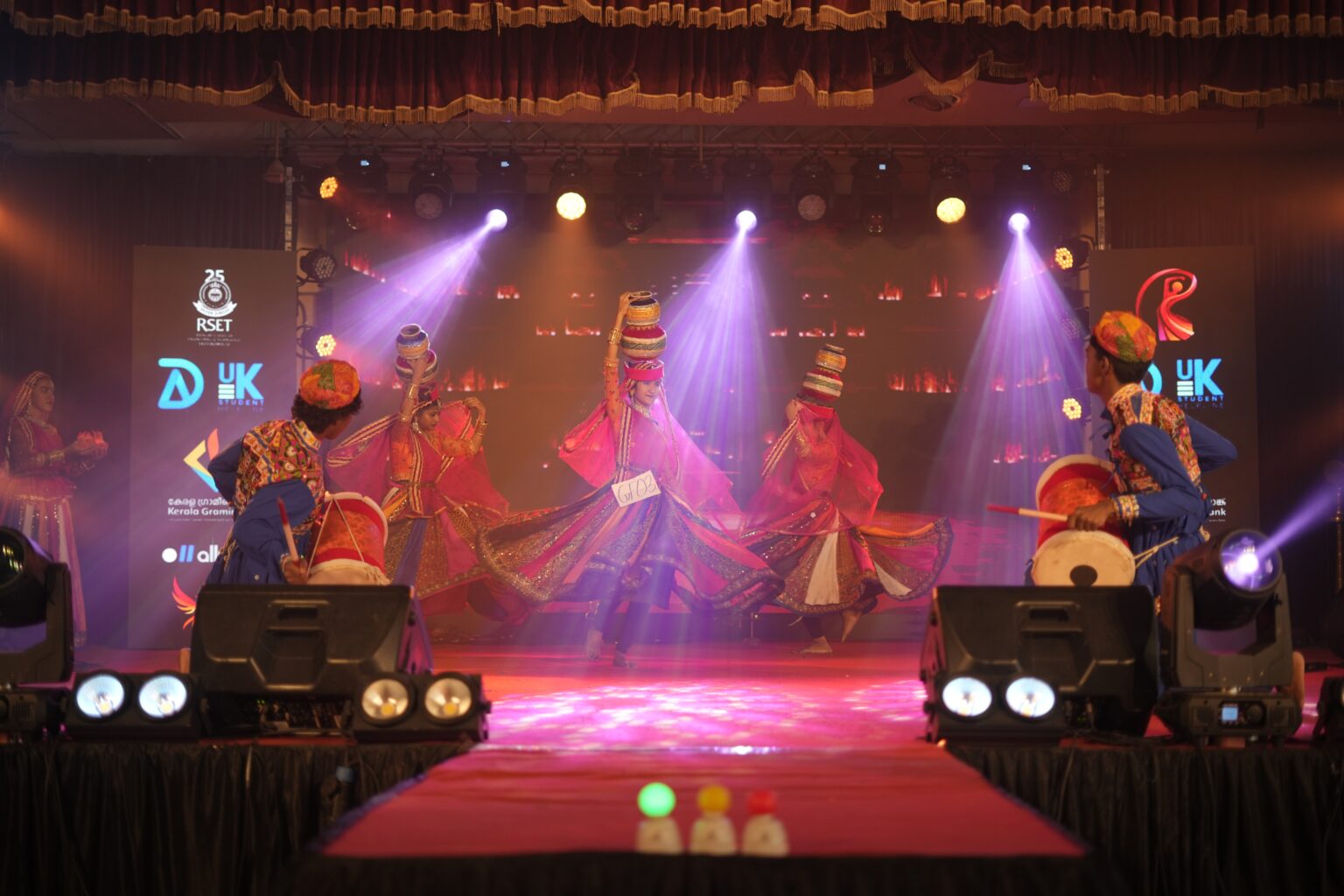
Bhaavam. Raagam. Thaalam. These essential ingredients come together to create the masterpiece that is Bharatham, RSET’s very own cultural fest. Bharatham stands strong as the highlight of our college lives, a respite for us students from our hectic academic schedule. Its 2026 edition spanned across three days from January 22nd to 24th. For these few days, the campus transformed– vivid fabrics stretched across open spaces, swaying gently above our heads like floating rainbows, while every corner had its own little artistic touch, making the whole place feel alive and buzzing with creativity.
Before Bharatham officially began, the pre-launch events were already quietly stirring the campus. Literary events like poetry writing, essay writing, and book reviews took place while many were lost in their own worlds with a canvas. These events set the stage for the main cultural events, ranging from music to dance.
The “ragam” of Bharatham 2026 was kick-started by the “Battle of Brahmas”, RSET’s eastern band competition. It features an intense musical jam between the five houses. Karthik from Rajputs further describes how instrumentalists are prioritised when choosing songs, as they form the technical backbone of the band. The House of Aryans reigned as champions of the Battle of Brahmas with a thrilling keytar performance and powerful vocals, followed by Spartans and Rajputs.
“Eastern music is a lot more complex in nature as they are playing with more non-Eastern instruments”
Jonathan of S8 ECE from House of Aryans
The theme show became the closing curtain for day one, with the theme, “Sustainable Development Goals”, challenging the houses creatively. Akshay and Gauri detail their storytelling approach with different members representing oil pollution, while others enacted corals and the theme of hope. The House of Aryans were the runners-up for this year’s theme show, followed by the House of Rajputs, who focused on the 16th SDG, “peace, justice and strong institutions” with justice placed in the centre and good and bad weighing on either side. Vikings displayed the theme of clean energy and climate change with members strutting the ramp, depicting clouds, flames and hydroelectric power. Drowsy eyes and frantic hands came together to produce a show like no other, rivalling high fashion itself.
By the second day, the whole vibe changed. The energy shifted toward the Battle of the Bands, arguably the most anticipated slot of the fest. Each house brought a distinct personality to the stage through hand-picked setlists and that raw, unpredictable charm that only comes with live performance. Some exclaimed, “The adrenaline you feel while performing can’t be compared to anything else.” There was nervousness, the inevitable technical glitches, and even a drumstick snapping mid-song, but the music never stopped. While the Vikings walked away with the win, the real soul of the event lived in the late-night rehearsals and the shared laughter that turned a competition into a collective journey.
The mesmerising synchro competition took place next. Synchronisation involves two individuals dancing on opposite sides of the stage with a wall blocking their view of each other. The pair must practice extensively and maintain a connection with the music and with each other to uphold their sync. Many participants were also in other events, so careful scheduling was essential for practice.
Day two had also included the exciting Western vocals competition. A fourth-year participant gives his take on the event. He mentions juggling projects, placements and internals while simultaneously preparing for his performance. When asked about what matters most in this competition, he states, “tone, clarity of voice, rhythm and confidence.” Experiencing his last Bharatham, he admitted it felt pretty strange, knowing he was done with college stages for good, but also kind of relieved he wouldn’t have to stress about losing his voice anymore. Western vocal performances eventually came to an end, fueled by adrenaline and sustained by talent.
Margamkali wasn’t easy at all, especially with everyone balancing multiple events and barely finding time to practice. There were a few tense moments along the way, but the audience’s support made everything feel lighter. In the end, the Mughals emerged as winners, leaving a mark with their dedication.
Day three, the most packed stretch of the festival, began at full pace with events taking place across venues, one of them being Drama. The Vikings claimed first place, followed by the Mughals and the Rajputs. The Rajputs’ adaptation of Crime and Punishment was particularly gripping, with a stellar performance by the protagonist, who carried a complex central role through a standout monologue. Preparation was brief, with much of the work done independently, he remarked. Surprisingly, the majority of the cast were first-years.
Oppana brought tradition and discipline to the forefront. The Vikings took first place, navigating tightly structured formations with constant grins despite the heavy ornaments adorning them. “Smiling through mistakes was a key part of the performance”, they said, hoping the audience would smile back. The Rajputs followed in second, while the Mughals placed third. Confidence and collective energy mattered more than flawlessness, especially amid packed schedules and overlapping events, according to the second runners-up.
The festival eventually drifted into a more intimate space with Eastern Unplugged. Despite lingering nerves about sound checks, as soon as the first notes floated out, the anxiety evaporated, and the connection with the crowd took over. “When the audience responds, you naturally give more than your best,” one performer said. The Vikings won the round, turning their own vulnerability into a strength that ended the event on a high note.
The Thematic dance held the room at full attention. The Mughals gave a performance set in a mental asylum, where their layered character work and detailed makeup stole the show. Practices stretched through the night, but it all paid off as they emerged victorious and became the college representatives for the intercollege event. Spartans followed in second with an insightful performance about substance abuse. Vikings placed third with a theme based on Operation Sindoor. Dina, a fourth-semester student, highlighted the challenge of sourcing soldier costumes right before Republic Day. “Thematic dance,” the performer reflected, “demands feeling the story, not just executing steps.” Vedika, a first-year student under Rajputs, credited the choreographer’s vision for shaping a performance centred around hope through a single song.
Intercollege marked the grand finale, carrying the anticipation built over the previous days. The Mughals brought more than just choreography onto the stage. Performing on home ground, they represented the college before a lineup of teams that were varied in theme, style and approach. The familiarity of the venue did lessen the pressure, but they still gave it their all. Their win was not just a house victory, but a moment of pride for the college itself, reflecting weeks of work and the strength of support behind them. For many watching, it felt like a celebration shared well beyond the stage.
Hearts raced and breaths became shallow as the points were tallied. The scoreboard pulsated forward and backwards, finally concluding. The House of Vikings erupted in cheers, sending an electrifying energy throughout the room. Bharatham 2026 was officially theirs to claim.
In the end, whether they finished on the podium or not, these three days revealed the depth of talent within our student body. Even in a setting often least associated with it, an engineering college, Bharatham stood as a reminder of what art can become when given room to breathe. After all, as Leonardo Da Vinci said, “Art is the Queen of all sciences communicating knowledge to all the generations of the world.” There’s no doubt that all those who took part in Bharatham, either as a participant or a spectator, left with memories that will stay long after the stages were cleared and the music faded.