
Throughout centuries, humans have achieved the pinnacle of excellence in various fields. The human mind and intellect has proven itself victorious through various discoveries, inventions, and man-made marvels. These range from the discovery of fire as cavemen to launching spacecrafts to venture into the unknown. Our history as a species is richly decorated with strength, tenacity, intellect, and culture. However, as bright as those days may seem, our ancestors had endured their own hardships—the downfall of empires, rule of dictators, economic ruin, famines, and a lot more.
As students and readers, more often than not we have tried to imagine ourselves during those times, making claims and plans of things we could’ve done better with the knowledge we have now—how we could have prevented mass destruction, suffering, and pain. However, it is exactly in situations like these we unknowingly succumb to short sight—our inherent human fallibility.
What produced great leaders and inventions also led to catastrophes and disasters. Though our intellect helps us recognise patterns and predict sources of conflict, our humanness, through our raw emotions, hinder our logic and judgement. And this isn’t new; the human psyche and our primal origin emotions have destroyed empires, societies, and nations. “History doesn’t repeat itself, it often just rhymes”—the quote holds truer here than anywhere else.
The question now arises: Why does everything that has happened before still keep happening, even in spite of the leaps we’ve made through as a species? The answer is, in fact, quite elementary and can be chalked down to the consistency of human emotions. This can be traced back to the very beginning; our most ancient ancestors who relied heavily on their primal instincts for survival. These instincts—tribalism, hoarding, hierarchies, and flight or fight—have only evolved to adapt since then.
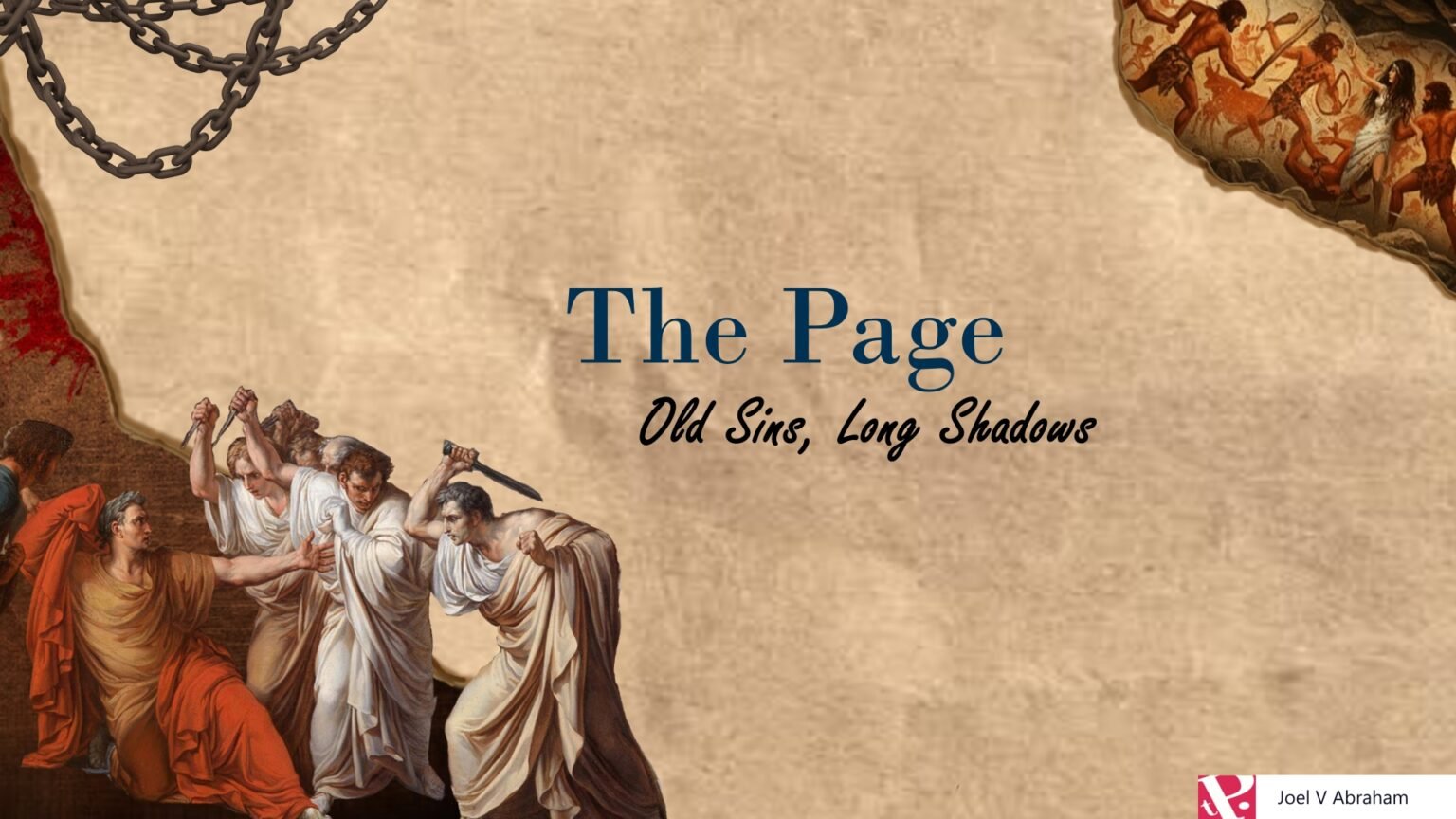
These primal instincts, along with our innate emotions, prove to be intense, so much so in most cases overwriting our logic. And in cases where external factors like peer stress, comfort, and status come into play, the results can turn out even more disastrous. Julius Caesar was one of the most influential rulers of the Roman Republic. Despite being a respected and just ruler, growing tensions plagued the senate and consul members, who feared Caesar was amassing too much power and showed intent on turning the republic into an empire. This caused them to plan out and execute the assasination of Caesar.
A similar tragedy was that of Rasputin, a well-known religious figure during early 20th-century Russia. Born into a peasant family, Rasputin quickly climbed the social ladder and established himself as a religious priest, said to cure people. His proximity to the royal Russian family and role in political decisions turned him into an enemy to the Russian public and nobility. People feared Rasputin was gaining unregulated power and control over the royal family and consequently managing political affairs. Eventually, a group of royalists by late 1916 had managed to kill him.
Both these events present the flawed and irrational emotional aspect that affect us even today. Although almost two millennia apart, these deaths highlight the peak of the human psyche and evolutionary traits. Rasputin’s death was mainly led on due to the prominence of tribalism. In a society or group of people, individuals can easily separate themselves based on certain factors. A given group may declare themselves of higher status and deem another to be lower than them—this is known as outhousing and is what the royal aristocrats exhibited against the common people. There was also greed for power and the desperation to avoid change.
This desperation is also a prominent factor, as most of our decisions and thoughts are often hindered by the fear of change, even if it is for the better. These same instincts are applicable to Caesar’s death—the fear of his holding all the power, and the possibility of transforming Rome into an empire (a huge change) terrified the senate. Here, cognitive dissonance and groupthink largely drove the party of over 60 to perform the crime. This occurs when many individuals become part of a group, and hence each person’s individual guilt and reasoning become diluted.
Accompanied by peer pressure, this can cause people to justify their actions, no matter how heinous. And the fact that Brutus, one of Caesar’s closest friends, was an orchestrator goes to show the intense effect groupthink and cognitive dissonance can have on a person. In such cases, people often tend to normalize and justify crude behaviour, eventually leading them to act on it. There have been numerous instances in history that prove the many follies of human emotion and instincts.
Besides the main reasons mentioned, the fear of change among the people played a significant role. The fear of turning Rome into a monarchy (though had it happened, it would have been led by a just ruler) and the fear of the collapse of the Russian monarchy both led to their downfall. While fear of change has always been a practical (and in most cases, required) response, when that change can bring about progress and development, it must be encouraged. Eventually, Caesar’s death led to the rise of the Roman Empire through his son, Octavious, and Rasputin’s demise led to massive riots and the downfall of the 200-year-old Romanov Dynasty. Had change been welcomed, both empires may have seen a chance of survival.
These causes resonate throughout various disasters and conflicts—where people often cling to their emotions, resist logical and emotional maturity, and cause suffering by supporting a crumbling state. The ideas and concepts here have been discussed by scholars and philosophers since time immemorial, and will continue to be a source of debate and discussion. All these vices share a commonplace in our daily lives, affecting every choice we make, and the course of our life.
So, before one begins to question the relevance of the fall of the Roman Dynasty with our student life, remember that our present will eventually ferment and transform into the past. Each choice one makes, irrespective of its scale, plays a significant role in crafting our future. So, before you make your next decision, allow yourself to absorb these ideas, and soon you’ll come to the realization that things are not always as they seem. No matter where you stand, your future remains entirely your own.